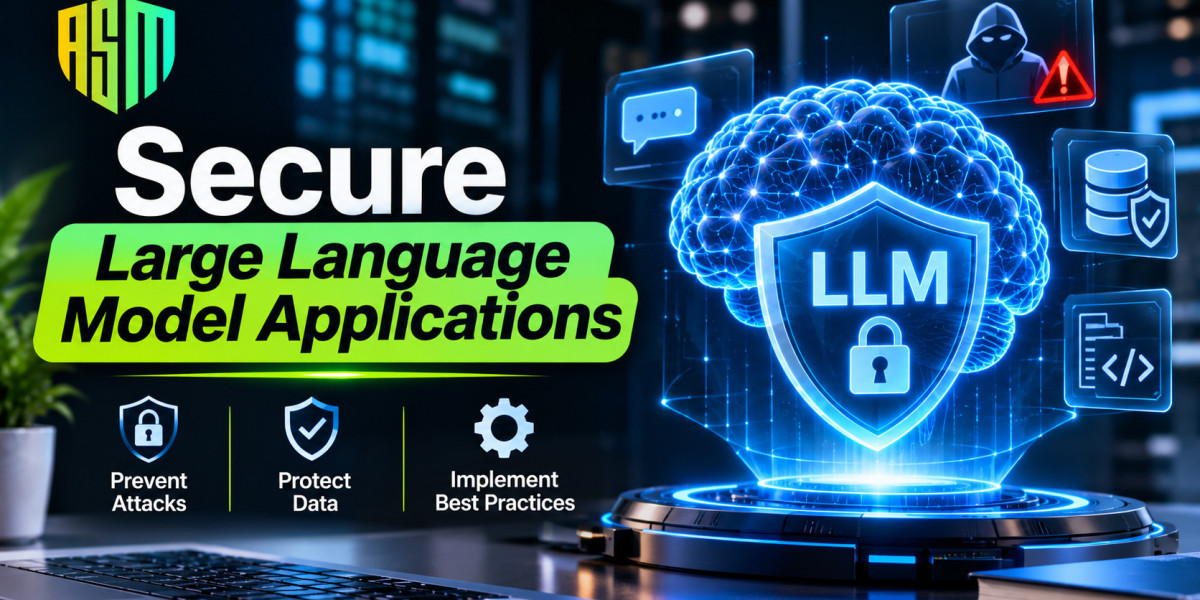

To secure a large language model application, treat the model as an untrusted component. Map trust boundaries, minimize and isolate data, verify every model and dependency, constrain tool permissions, validate all output, cap resource use and monitor behavior in production. Map each control to the OWASP Top 10 for Large Language Models so nothing is missed.Most teams meet LLM security the same way a prototype works well, a stakeholder asks for production and someone finally asks what could go wrong. By then the model already reads customer data, calls internal tools and writes text that other systems consume.
This OWASP LLM security guide takes the builder's view. Instead of cataloguing attacks, it follows the lifecycle of a feature and shows which controls belong at each stage.The advice is organized around the OWASP Top 10 for Large Language Models, but sequenced the way real projects unfold design, data, supply chain, runtime and operations. If you want the full catalogue of risks first, start with our OWASP Top 10 for LLM Applications overview and return here for the implementation steps.
Why Generative AI Application Security Needs a Different Mindset
Conventional software behaves deterministically. Given the same input and code, it produces the same output, which makes testing and reasoning about security relatively tractable. A language model is probabilistic. The same prompt can yield different answers and instructions embedded in data can change behavior in ways no developer wrote.That has three practical consequences. First, you cannot rely on instructions in a prompt as a security control, because a determined user may override them. Second, the model's context window is a shared space where trusted instructions and untrusted content mix. Third, anything the model can reach, an attacker who controls its input may also reach. Secure AI development therefore means moving every real guarantee out of the prompt and into surrounding code, infrastructure and policy.
Step 1 Map Your Architecture and Trust Boundaries
Before choosing controls, draw the system. Mark where user input enters, which documents the model retrieves, which tools it can call, which accounts those tools use and where the output is displayed or executed. Highlight every point where untrusted text meets a privileged action. Those points are your priority list.
This exercise is threat modeling applied to an AI feature and it does not need to be heavy. A one hour workshop with a developer, a product owner and a security engineer will usually surface the most dangerous paths. Ask four questions for each component: what can it read, what can it change, who can influence its input and what happens if it is wrong or malicious? Record the answers, because they become the requirements for every step that follows.
Step 2 Protect the Data the Model Touches
Data is where many LLM incidents begin. Three OWASP categories converge here: sensitive information disclosure, data and model poisoning and vector and embedding weaknesses.Minimize what enters the context. Send the model only the fields it needs for the task. If a summary feature does not need email addresses or account numbers, strip them before the request is built.Enforce permissions at retrieval time. In a retrieval/augmented generation system, check the requesting user's access to each document when the query runs. Filtering results after generation is too late, because the model has already seen the content. Partition indexes by tenant or sensitivity level when the data model allows it.
Control what goes in. Review documents before they are ingested into a vector store, record their source and keep the ability to remove a poisoned item quickly. If you finetune, keep lineage records for the training set and hold back a clean evaluation set that outsiders cannot influence.Protect the store itself. Vector databases need authentication, network restrictions, encryption and backups like any other data service. Apply the same cloud security best practices you use for databases and object storage, including secrets management and logging.
Step 3 Lock Down the Model Supply Chain
A production LLM feature stands on many third party pieces: base models, adapters, tokenizers, datasets, orchestration libraries, plugins and hosted APIs. Each is a place where tampering can enter. This is the supply chain category and it is easy to underestimate because model files do not look like code.
Practical controls include downloading models only from sources you have vetted, verifying checksums or signatures and preferring file formats that cannot run code on load. Some older formats rely on serialization mechanisms with the same weaknesses described in our guide to insecure deserialization, so loading an unknown model file deserves the same suspicion as opening an unknown binary.Keep a bill of materials that lists models, datasets and libraries with versions. Pin dependencies, scan them on a schedule and decide in advance how you will swap a component if it is reported as compromised. For hosted model providers, review data retention terms, regional processing and incident notification commitments before you send real data.
Step 4 Harden Inputs and Prompts
Prompt injection is the best known LLM risk and it has no complete fix. The goal is to make successful injection less likely and far less damaging.Separate trusted instructions from untrusted content using clear structure and tell the model to treat retrieved text as data. Limit input length, reject obviously malformed requests and screen for known abuse patterns, understanding that filters will miss novel phrasing. Keep sensitive instructions out of places the user can influence.Most importantly, assume some injections will work and design the rest of the system accordingly. If a successful injection can only draft text for a human to review, it is a nuisance. If it can trigger payments or deletions, it is a serious incident. Our article on the prompt injection attack shows how this plays out step by step.Also avoid placing secrets in the system prompt. System prompt leakage is a distinct OWASP category and the safest assumption is that the prompt will eventually be read. Put credentials in a secrets manager and enforce rules in code.
Step 5 Constrain Agents and Tools
When a model can call tools, its mistakes become actions. Excessive agency is about reducing that blast radius.Give each tool the narrowest possible scope. A function that reads one customer's order history is safer than a general database query tool. Run tools with the identity and permissions of the requesting user, not a powerful shared account, so the model cannot reach records the user could not reach directly. A shared account recreates the weakness explained in our guide to insecure direct object references.Require human approval for irreversible or highvalue actions, such as sending external messages, moving money, or deleting data. Log every tool call with the request that triggered it. Limit how many steps an agent may take in a single run so a confused loop cannot continue indefinitely.
Step 6 Validate and Handle Output Safely
Whatever the model returns, downstream code must treat it as untrusted. Improper output handling is the category that connects LLM risk to classic vulnerabilities such as crosssite scripting, command execution and query manipulation.
Ask the model for structured output and validate it against a strict schema before using it. Encode text for the context where it will appear, such as HTML or a shell argument. Never build database queries by concatenating model output; use parameterized statements. The principles are identical to the ones in our developer guide to injection attacks and you can sharpen the skill with a practical SQL injection lab.Do not forget misinformation. For outputs that influence decisions, require citations or source links, flag low confidence answers and route high stakes items to review.
Step 7 Control Resource Use and Cost
Unbounded consumption turns the model into a lever for denial of service and denial of wallet. Put limits at several layers peruser rate limits, caps on input and output tokens, request timeouts and a ceiling on concurrent jobs. Add budget alerts that notify a human long before a monthly limit is reached.Authentication is part of this control. Anonymous endpoints that call a paid model invite abuse. Where model extraction is a concern, monitor for unusual query patterns such as systematic probing of a narrow task and consider returning less detail, such as omitting raw probabilities, to make copying harder.
Do Not Neglect the Web Stack Around the Model
An LLM feature almost always lives inside a conventional web application and the old weaknesses still apply. Sessions, authentication, API authorization and input validation around the model matter as much as anything inside it. If the endpoint that calls the model lacks proper access control, no amount of prompt engineering will help.Review the surrounding application against the classic OWASP Top 10 for web applications in parallel with the LLM list. Teams often find that the most serious issue in an AI feature is a familiar one, such as a missing authorization check on a new internal API that the model calls. Treating both lists as complementary prevents blind spots.
Write Security Requirements Before You Build
Concrete requirements keep security from becoming an afterthought. Before development begins, write short, testable statements such as the model may never receive data classified above the user's clearance; every tool call runs with the end user's permissions; no secret appears in any prompt template; all model output is validated against a schema before use; and each endpoint enforces peruser token limits.Attach each requirement to an owner and a test. A requirement that cannot be tested will be quietly dropped under deadline pressure. Review the list at design time, again before launch and whenever the feature gains a new capability. This small habit makes later audits far easier, because you can show not only what controls exist but why they were chosen.
Step 8 Monitor, Test and Respond
Security work continues after launch. Log prompts, retrieved sources, tool calls and outputs with appropriate privacy controls so investigations are possible. Define signals worth alerting on repeated refusal bypass attempts, unusual toolcall sequences, spikes in token use and outputs containing patterns that look like keys or personal data.Build an adversarial test set from your own threat model and run it whenever you change the prompt, the model, a tool, or the retrieval index. Prepare an incident playbook that covers disabling a tool, rotating credentials, removing a poisoned document and switching to a fallback model. Practice it before you need it.
Build Security Into the Team Workflow
Controls only last when they fit how people already work. Add an AI section to your pull request template that asks what data the change sends to the model, which tools it exposes and how output is validated. Include prompt templates and tool definitions in code review, since a small wording change can alter behavior as much as a code change does.Give developers safe defaults through shared libraries a wrapper that applies token limits, a retrieval helper that enforces permissions and an output validator that rejects malformed responses. When the secure path is also the easiest path, adoption follows without constant policing.If your team uses coding assistants, build a review habit using our guide on how to review AI generated code.
Secure AI Development Checklist by OWASP Category
OWASP Category | Key Control | Where It Lives |
Prompt Injection | Least privilege, content separation, approvals | Application code |
Sensitive Information Disclosure | Data minimization, retrieval access checks | Data layer |
Supply Chain | Provenance checks, pinned versions, safe formats | Build pipeline |
Data and Model Poisoning | Lineage tracking, ingestion review | Data pipeline |
Improper Output Handling | Schema validation, encoding, parameterized queries | Application code |
Excessive Agency | Narrow tools, userscoped identity, confirmation | Tool layer |
System Prompt Leakage | No secrets in prompts, server side rules | Architecture |
Vector and Embedding Weaknesses | Tenant partitioning, permissionaware search | Retrieval layer |
Misinformation | Grounding, citations, human review | Product design |
Unbounded Consumption | Rate limits, token caps, spend alerts | Gateway |
Conclusion
Securing a language model application is mostly about what surrounds the model. Start by mapping trust boundaries, protect the data the model reads, verify what you download, narrow what the model can do, validate what it says and cap what it can spend. Then monitor continuously and rehearse your response. Teams that follow this lifecycle turn the OWASP Top 10 for Large Language Models from a reading list into a repeatable engineering practice that keeps pace with the product.Practicing this reasoning with exercises from our threat modeling practice material makes it second nature and the labs on AppSecMaster give developers a place to try attacks and fixes safely.
Frequently Asked Questions (FAQs)
How do you secure a large language model application?
Treat the model as untrusted, map trust boundaries, minimize data exposure, enforce access control outside the model, restrict tool permissions, validate output, limit resource use and monitor production behavior. Test with adversarial inputs whenever the prompt, model, or tools change.
What is the most important control for LLM applications?
Least privilege is usually the most valuable. If the model and its tools can only reach the data and actions the current user is allowed to use, successful prompt injection or model error has a limited impact.
Can prompt injection be fully prevented?
Not with current technology. Models cannot reliably distinguish instructions from data. The practical approach is layered defense, reduce privileges, separate untrusted content, validate output, require approval for risky actions and test regularly.
Should secrets ever be placed in a system prompt?
No. Assume the system prompt can be extracted. Store credentials in a secrets manager, enforce authorization in application code and keep the prompt limited to behavior and style guidance.
How often should an LLM application be reviewed?
Review whenever you add a tool, data source, or model version and run a scheduled assessment at least quarterly. Automated adversarial tests in your release pipeline catch regressions between manual reviews.