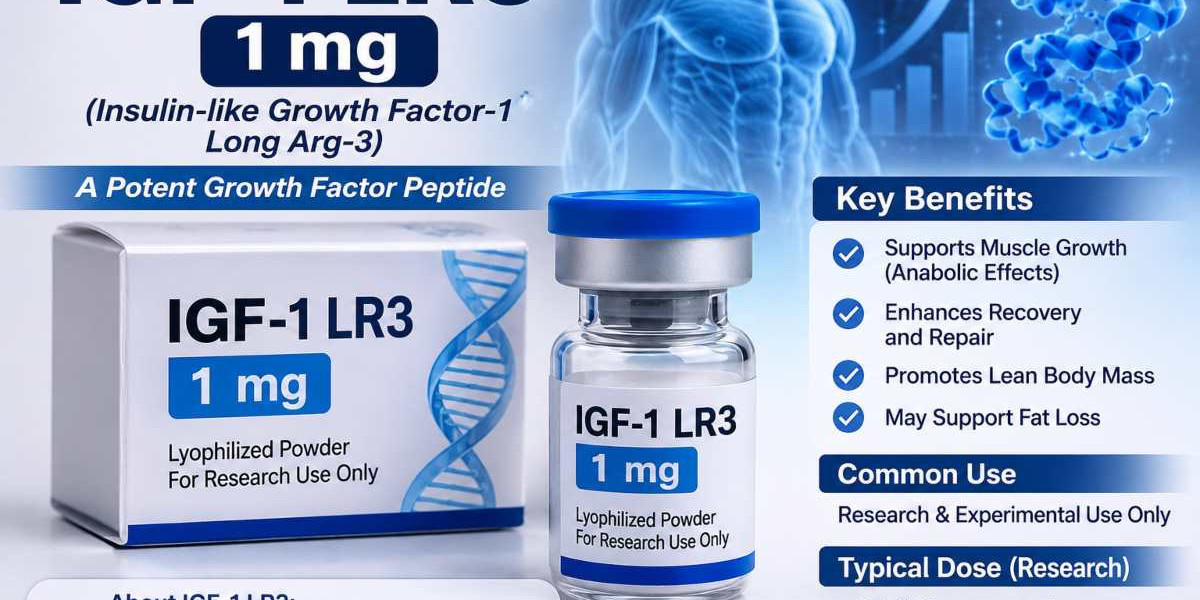

Ordering igf-1 lr3 1mg looks easy. Then you meet ten suppliers, ten prices, and very little proof. Who do you trust?This guide gives you five clear checks. Use them to compare sources and protect your research data.Note: IGF-1 LR3 is sold for laboratory research use only.
What Is IGF-1 LR3?
IGF-1 LR3 is a lab-modified version of insulin-like growth factor 1. The “LR3” stands for “Long R3.”It carries an arginine swap at position 3 and a 13-residue extension at the start of the chain.In vitro, these changes reduce binding to IGF binding proteins. That is why researchers use it as a reagent in cell-culture and signaling work.
Why Labs Choose a 1mg Vial
A 1mg igf-1 lr3 vial fits small studies well. Many buyers type 1 lr3 1mg into search when they plan a pilot project.
Here is why this size is popular:
Less leftover material on small projects
Easier lot tracking, with one vial per batch record
Lower upfront cost when testing a new supplier
Simpler inventory for shared lab spaces
Does your project need a larger scale? Start small, then reorder once the supplier proves reliable.
Common Research Contexts
IGF-1 LR3 appears in several kinds of in vitro work:
Cell-culture proliferation assays
Signaling pathway studies, such as PI3K/Akt
Receptor binding comparisons
Stability studies against native IGF-1
Each use depends on consistent quality. A weak batch can ruin weeks of work.
How to Evaluate IGF-1 LR3 1mg Quality
Not every vial is equal. Use this five-point checklist:
Third-party COA: ask for a Certificate of Analysis from an independent lab, not the seller’s own report.
HPLC purity: many reputable suppliers publish results of 98% or higher.
Mass spec identity: this confirms the compound matches the label.
Matching lot numbers: the number on the vial must match the COA.
Clear labeling: look for a sealed vial marked for research use only.
Here is a quick example. Your COA lists lot 24A15, but the vial reads 24B02. That mismatch is a stop sign.
Before you order, confirm all five points. If a supplier cannot show them, move on.
Red Flags to Avoid
Walk away if you notice any of these:
No COA, or a generic COA that never names the product
Missing or mismatched lot numbers
Claims about human results or health outcomes
Dosing or injection directions on a chemical reagent listing
Vague details about origin or testing
Be extra careful with any 1mg igf 1 lr3 listing that promises human benefits. Real research suppliers do not make those claims.
A Simple Supplier Scorecard
Want an easy way to compare sources? Score each supplier from 0 to 2 on five items:
COA availability
Purity data
Lot number match
Research-use labeling
Support response speed
A total of 8 or higher is a solid start. For example, a supplier with a full COA (2), purity data (2), matching lot (2), clear labeling (2), and slow support (1) scores 9.
Smart Handling and Record-Keeping
Good records protect your data and make results easier to repeat.
Follow the supplier’s storage guidance on the label and COA
Keep vials sealed until your protocol calls for them
Avoid repeated temperature swings
Log the lot number, receipt date, and storage conditions
Label every container clearly
Small habits now save big headaches later. Reviewers and lab managers both value a clean paper trail.
Common Buying Mistakes
Even careful buyers slip up. Watch for these:
Choosing by price alone
Skipping the lot number check
Ignoring shipping times to your lab
Mixing up product names or vial sizes
Forgetting to save the COA with your records
Which one have you seen most often? Fixing even one can improve your results.
Questions to Ask Before Buying IGF-1 LR3 1mg
A short chat with a supplier reveals a lot. Ask these:
Do you publish a COA for every batch?
Is testing done by an independent lab?
Do you ship from a U.S. location, and how fast?
Are all products labeled for research use only?
What is your return policy?
Put the answers in a simple table. When you compare several 1mg igf 1 lr3 listings, patterns show up fast.Fast replies and clear answers usually signal a tighter operation. Vague replies usually signal the opposite.
Frequently Asked Questions
What is IGF-1 LR3 1mg used for in research?
Labs use it in in vitro work, such as cell-culture assays and signaling studies. It is a research reagent only.
Is it meant for human use?
No. It is sold as a chemical reagent for laboratory research only. It is not for human consumption.
How can I confirm purity?
Request the batch COA. Look for HPLC purity data and mass spec identity confirmation, then match the lot number to your vial.
Why is a 1mg vial so common?
Researchers who search igf 1 lr3 1mg usually plan small or pilot studies. A smaller vial limits waste while they test a new source.
Conclusion
Choosing igf-1 lr3 1mg comes down to proof. Look for third-party testing, matching lot numbers, clear labeling, and honest research-only language.Whether you need one 1mg igf-1 lr3 vial or several, run the checklist every time.Ready to source with confidence? Browse our IGF-1 LR3 research vial and request the batch COA before you order.
Disclaimer: This article is for informational purposes only and is not medical advice. IGF-1 LR3 is sold for laboratory research use only and is not for human consumption. It is not intended to diagnose, treat, cure, or prevent any disease. Consult a qualified professional for any health questions.